Blue light glasses are useful only when the problem has been named correctly. In clinic-facing evidence reviews, the distinction matters: a patient with dry, burning eyes after spreadsheet work is not describing the same physiology as a patient whose sleep timing shifts after late-night tablet use.
The lenses can filter part of the high-energy visible spectrum. They do not, by themselves, fix posture, blink suppression, an outdated prescription, or a binocular vision problem that shows up only after sustained near work. That is the frame I use when comparing the clinical record: separate sleep timing from physical eye fatigue, then match the intervention to the mechanism.
Table of Contents
- The Physiology of Digital Eye Strain
- Mechanisms of High-Energy Visible (HEV) Light
- Evaluating the Efficacy of Blue Light Lenses
- Clinical Limitations and Scope of Protection
- Implementation Guidelines for Digital Device Users
The Physiology of Digital Eye Strain
Computer Vision Syndrome starts with sustained visual demand
Computer Vision Syndrome, often shortened to CVS, describes the cluster of symptoms that can appear during or after extended digital device use: tired eyes, dryness, burning, intermittent blur, headache, and sometimes neck or shoulder discomfort when the workstation pulls the body into a strained position.
The baseline problem is usually not light alone. It is the way a screen holds the visual system at a fixed near distance while the ocular surface receives fewer full blinks. Typical desktop monitors sit at a focal distance of roughly 50 to 70 centimeters, which asks the accommodative system to hold a steady contraction for long stretches.
Normal blink rates run about 15 blinks per minute. During continuous digital reading, that rate can fall to about 5 blinks per minute. That single change explains much of what patients call screen fatigue: the tear film breaks up faster, the corneal surface becomes less smooth, and vision may clear briefly after a deliberate blink.
Glare, blink rate, and emitted light are different variables
Clinical reviewers have separated users working on high-glare screens from those reading on low-glare e-ink displays to isolate the driver of symptoms. The consistent lesson is practical: glare can make a display uncomfortable, but prolonged near-focus work and blink suppression carry much of the physiologic load.
That distinction changes the recommendation. A glare-heavy office may benefit from anti-reflective lens coatings and better screen positioning. A dry-eye pattern calls for blink training, tear-film assessment, and work-rest intervals. A late-night screen habit raises a different question: circadian signaling.
Critical Insight: Blue light glasses should not be treated as a general antidote for digital eye strain. They are one possible tool in a broader visual hygiene plan.
Mechanisms of High-Energy Visible (HEV) Light
Where blue light sits in the visible spectrum
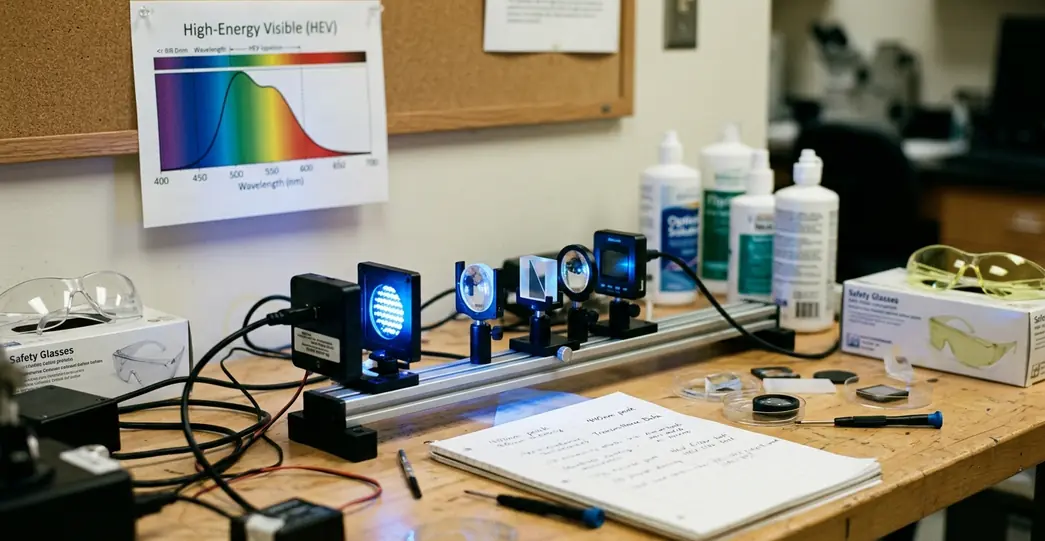
High-Energy Visible light refers to the shorter-wavelength end of visible light. Blue light is commonly discussed in the 380 to 500 nanometer band, with particular attention to the 400 to 480 nanometer range because of its interaction with retinal photoreceptors involved in circadian regulation.
Researchers have mapped the spectral power distribution of standard LED monitors against midday sunlight to establish a realistic comparison. That comparison is often missing from consumer conversations. Midday sunlight delivers irradiance levels often exceeding roughly 100,000 lux, while typical backlit displays emit roughly 150 to 250 lux.
How the eye handles HEV exposure
The cornea and crystalline lens act as selective filters. They absorb nearly all ultraviolet radiation below 295 nanometers, which is one reason UV protection has a clear ocular safety role. Visible blue light in the 380 to 500 nanometer band, however, is transmitted to the retina.
Transmission does not automatically mean harm. The retina receives blue light every day under normal environmental conditions, especially outdoors. The clinical question is dose, timing, and tissue susceptibility, not the mere presence of blue wavelengths.
That is why an evening tablet session and a noon walk are biologically different events. Outdoor light is far brighter. Evening screen exposure is dimmer, but it arrives at a time when the circadian system may be preparing for melatonin release.
Evaluating the Efficacy of Blue Light Lenses
Filtration is real, but the percentage matters
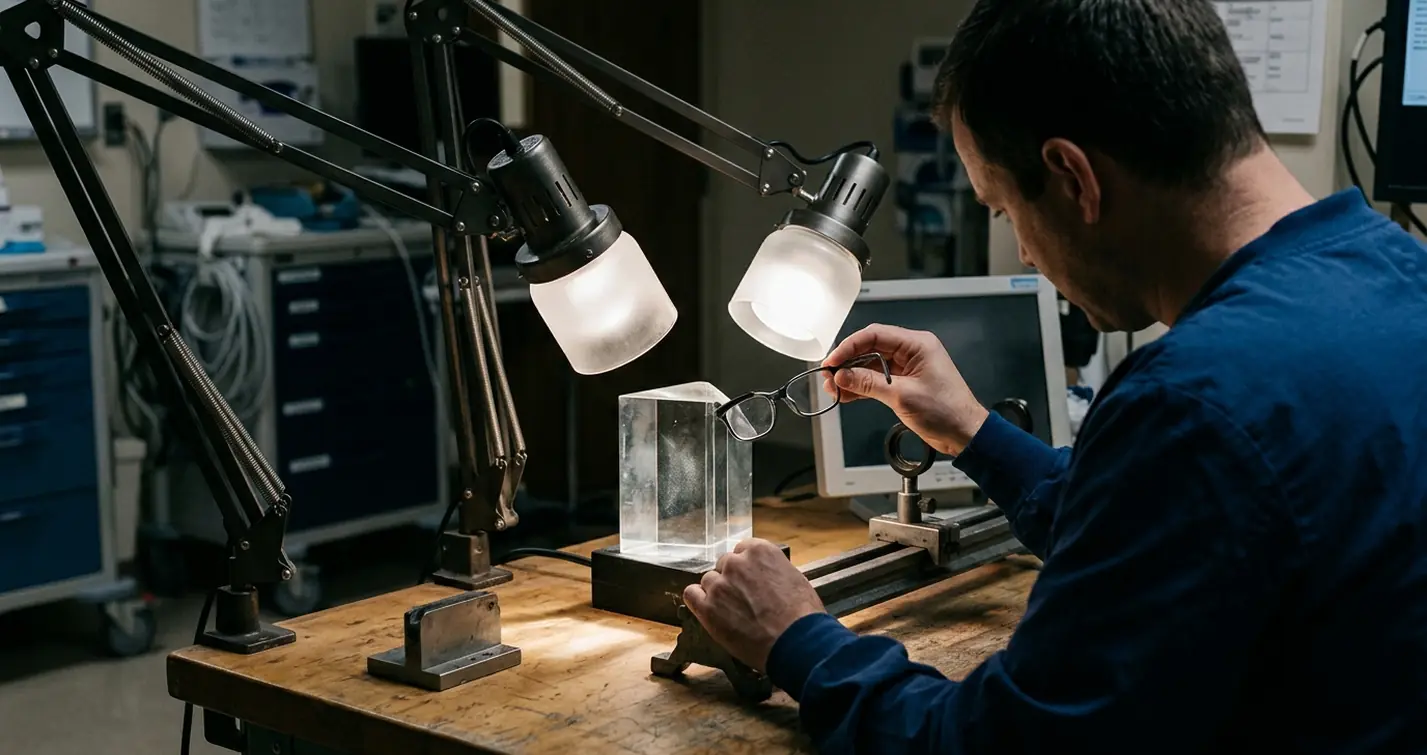
Blue-blocking coatings are not imaginary. Clear blue-blocking lenses typically filter about 10 to 15 percent of HEV light in the 400 to 450 nanometer range. That physical filtration can be measured during optical testing.
The harder question is whether that amount of filtration translates into less physical eye fatigue. Current optometric consensus is cautious: blue light lenses can reduce selected wavelengths, but the evidence does not show a direct, reliable reduction in the dry, tired, aching symptoms that most patients mean by digital eye strain.
Early study designs tried to quantify eye-fatigue reduction with subjective user questionnaires. That approach ran into a familiar problem in lens research: high placebo response rates. The more defensible clinical interpretation is to keep the outcome specific. Ask whether the lens changes glare, sleep timing, or visual comfort under defined conditions rather than asking whether it broadly cures screen fatigue.
The stronger case is circadian timing
The sleep evidence is more coherent. Evening screen use without filtration can delay endogenous melatonin onset by roughly 60 to 90 minutes. That does not mean every person will experience the same delay; the degree of melatonin suppression varies with baseline pupillary diameter and the ambient room illumination during screen use.
Still, the mechanism fits the intervention. Filtering blue-weighted light in the evening reduces one signal that tells the circadian system it is still daytime. The benefit is most relevant for people who work at screens after dusk, read on tablets in bed, or shift between bright devices and dark rooms late in the evening.
For daytime office fatigue, the recommendation changes. Clear blue-blocking lenses may be harmless for many users, but an anti-reflective coating, accurate prescription, proper monitor distance, and blink-rest routine usually address the more likely causes.
Recommendation: Use blue-filtering lenses for evening light management, not as the first-line explanation for daytime screen discomfort.
Clinical Limitations and Scope of Protection
Macular degeneration claims exceed the evidence
A common concern is that screen-emitted blue light causes macular degeneration. Current clinical data does not support that claim. Longitudinal retinal imaging from heavy computer users over a five-year period has not shown that consumer electronics emit enough phototoxic energy to induce macular injury.
The exposure math is important. The maximum retinal irradiance from a smartphone viewed at around 20 centimeters has been reported at less than one-hundredth of the threshold required to cause acute photochemical damage to the macula. That finding does not make every screen habit healthy, but it does narrow the concern to the correct mechanisms: visual load, glare, ocular surface stress, and circadian timing.
The American Academy of Ophthalmology guidelines on digital eye strain make a similar practical distinction between blue light fear and the more common causes of screen-related symptoms.
Specialized lenses cannot correct an uncorrected problem
Patients with uncorrected astigmatism sometimes report continued headaches despite wearing premium blue-light filtering lenses. That pattern is not surprising. A tint cannot sharpen an unfocused retinal image, and it cannot correct the extra accommodative effort caused by an inaccurate prescription.
Binocular vision problems can hide in the same way. A person may read comfortably for ten minutes, then develop brow ache or intermittent blur after an hour because the two eyes are not coordinating efficiently at near distance. Blue-filtering lenses do not diagnose that issue.
Glare relief is a separate matter. Anti-reflective coatings often provide more immediate benefit than blue-blocking tints alone in offices with overhead fluorescent fixtures, because reflections on the lens surface and screen reduce contrast. That effect has limits: in a completely dark room, anti-reflective coatings offer negligible visual comfort improvement because overhead reflection is no longer the main stimulus.
Risk Factor: Persistent headaches, double vision, or blur after short periods of screen use should be evaluated as a refractive or binocular vision problem before being attributed to blue light.
Implementation Guidelines for Digital Device Users
Choose eyewear by the job it needs to do
The most useful lens plan starts with the environment. For daytime desk work, prioritize an accurate prescription and a high-quality anti-reflective coating, especially if overhead lighting or window reflections wash out the display. If evening screen exposure is the concern, a slight amber tint may be more relevant than a clear coating alone.
Amber-tinted lenses designed for evening use can block up to about 65 percent of light in the 450 to 480 nanometer spectrum. That stronger filtration also changes color perception, so it is not the right choice for every task. Someone editing photographs at night may need different controls than someone answering email before bed.
Pair lenses with the 20-20-20 protocol
Passive filtration should be paired with active visual breaks. During protocol evaluations, the 20-20-20 protocol is simple, but it works only when followed deliberately: every 20 minutes, shift focus to an object at least 6 meters away for a minimum of 20 seconds.
- Set the monitor at a comfortable working distance rather than leaning toward the display.
- Reduce glare by adjusting screen angle, nearby lamps, or window position.
- Blink fully several times when beginning a visual break.
- Look at a distant object for at least 20 seconds before returning to near work.
- Reserve amber or stronger blue-filtering lenses for evening use when sleep timing is the clinical target.
This protocol addresses accommodation, blink suppression, and attention lock. The glasses address only the spectral component.
Know when to seek an exam
A comprehensive eye exam is the right next step when symptoms persist despite better screen habits. The exam can identify uncorrected astigmatism, dry eye disease, accommodative strain, and binocular vision issues that a retail lens purchase will miss.
Assessment should come before escalation. If a patient reports that blue light glasses helped sleep but not headaches, that is useful information. If the same patient still squints at a monitor 50 centimeters away, the more likely answer is optical correction, workstation adjustment, or binocular testing.
For this topic, the evidentiary boundary is narrow: timing, glare, and refraction are better characterized than lifelong retinal outcomes. Blue light glasses can be part of a careful plan, but they work best when assigned to the problem they can actually influence.