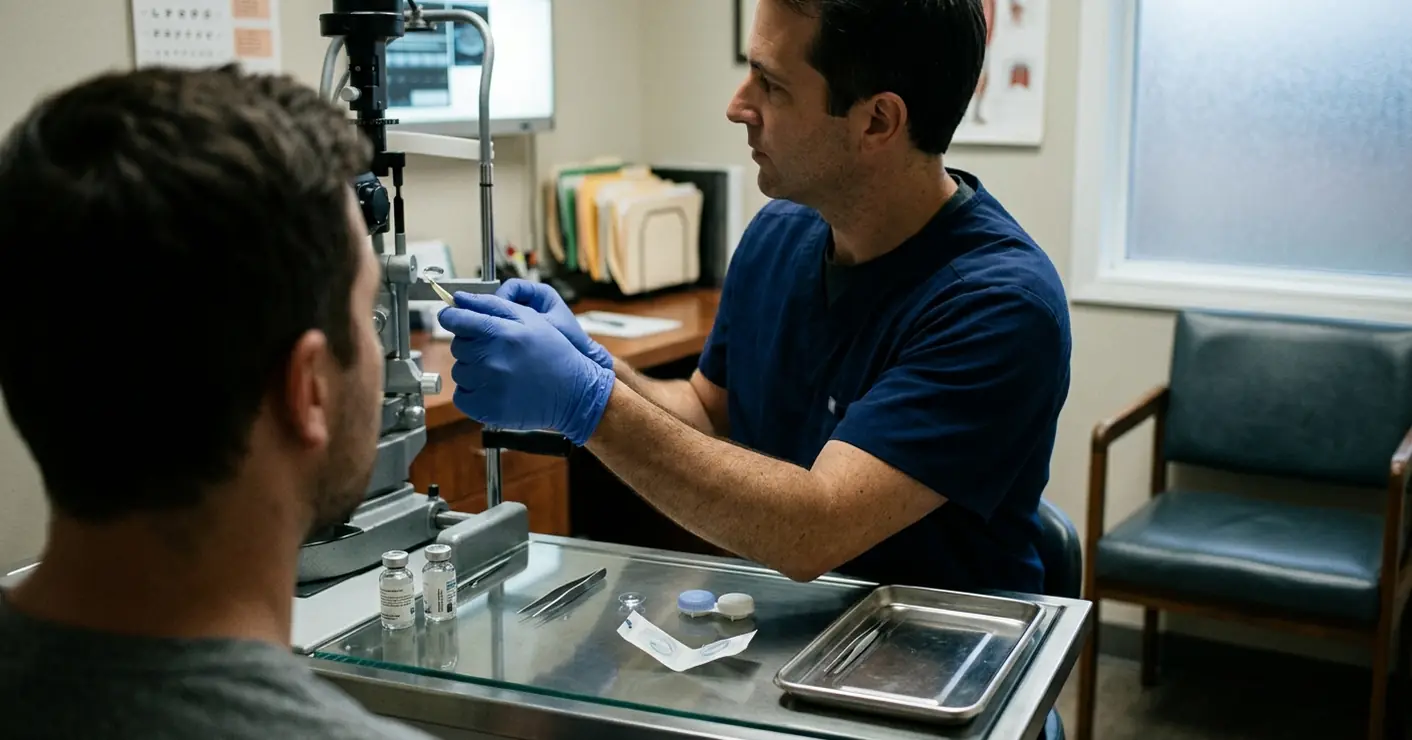
A patient walks in convinced their prescription is wrong. Their vision is sharp for a while, then it smears at the edges, then it clears again with a blink. They've had three pairs of glasses in eighteen months and none of them fixed the headaches that show up mid-afternoon. Often, the culprit isn't a bad prescription. It's astigmatism being corrected with the wrong lens design.
The Visual Stakes of Uncorrected Astigmatism
Astigmatism that is left uncorrected doesn't announce itself with sudden blindness. It grinds you down slowly.
The classic presentation shows up in the patient history before it shows up on any chart. People describe tension headaches that arrive like clockwork after concentrated near-work, often reported as roughly three to four-and-a-half hours into a task. They report that the words on a screen seem to shift focus between blinks, and when tested, their visual acuity genuinely fluctuates by a line or two on the Snellen chart from one moment to the next.
That fluctuation is the tell. A healthy eye reading through a well-matched correction holds steady. An astigmatic eye reading through a spherical lens is doing constant work, hunting for a single point of focus that the optics simply won't give it.
Using a lens designed for the eye's irregular curvature isn't a comfort upgrade. It's what keeps the visual system from burning energy all day on a problem it can never solve on its own.
Why Standard Spherical Lenses Fail
Picture a perfectly round basketball. Now picture a football. The basketball focuses light to a single clean point; the football, curved more steeply along one axis than the other, splits incoming light into multiple focal points. That's astigmatism in one image. For a fuller clinical definition of astigmatism, the National Eye Institute is a reliable starting point.
Here's where the standard contact lens runs into trouble. A spherical lens carries the same power across its entire surface, and it's built to rotate freely on the eye with every blink. For someone whose eye is uniformly round, that free spin is harmless. The correction looks identical no matter how the lens sits.
An astigmatic eye needs its correction locked to specific meridians. The steep axis and the flat axis each demand a different power, aimed at a fixed orientation. A lens that spins ten to fifteen degrees with each blink can never hold that alignment.
This is why patients with astigmatism above roughly 0.75 diopters rarely tolerate spherical contacts. The math simply doesn't hold still long enough to correct anything. Every blink resets the optical alignment, and the eye starts its search all over again.
The Engineering and Stabilization of Toric Lenses
Toric lenses solve the alignment problem by building different refractive powers into different meridians of the lens. One part of the lens corrects the steep axis, another corrects the flat axis, and the whole design only works if it stays put.
Keeping it put is the entire engineering challenge, and manufacturers have settled on two dominant approaches.
Prism Ballast
The oldest reliable method adds weight to the bottom of the lens. A prism ballast design thickens the inferior edge by roughly 0.12 to 0.18 millimeters, letting gravity and the lower eyelid pull the lens into a consistent resting position. Early practitioners chased the same goal by truncation, literally slicing off the bottom edge so it sat flat against the lid. That approach fell out of favor once thickness profiles could be engineered more gently.
Dynamic Stabilization
The newer approach uses the eyelids as active partners. Thin zones tapering down to around 0.05 millimeters at the horizontal meridians let the pressure of a natural blink squeeze the lens back into orientation. There's no heavy bottom edge to fight; the lids do the aligning.
Where Stability Breaks Down
A toric lens is only as stable as the anatomy holding it. Eyelid tension, tear film quality, and blink dynamics all influence whether the lens stays oriented. Prism ballast designs struggle in patients with severe dry eye, where the thicker inferior edge drags against the lower lid and aggravates friction through every blink cycle. Patients with unusually tight eyelids can see excessive rotation with ballast and do far better on a dual thin-zone method. Expect some transient blur during rapid eye movement even in a well-fitted lens.
None of these mechanisms is universally superior. The right one depends on the eye it's sitting on, which is precisely why the fitting process carries so much weight.
The Clinical Fitting and Evaluation Process
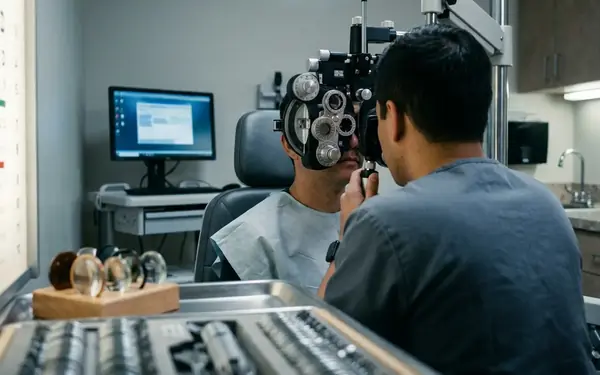
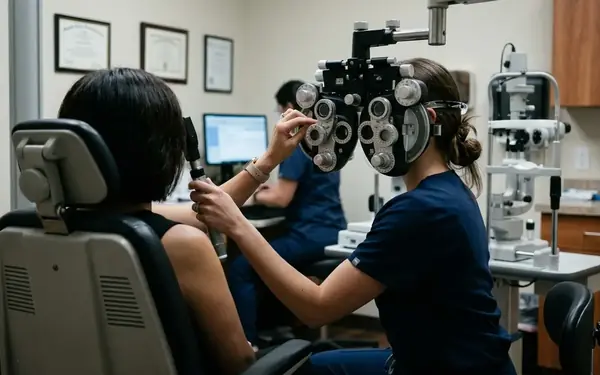
You cannot fit a toric lens off a refraction alone. The eye has to be mapped first.
Corneal topography comes before lens selection. The scan charts the exact curvature and axis of the cornea, revealing where the steep and flat meridians actually sit rather than where a chair-side refraction estimates them. That map dictates which lens power and axis to trial in the first place.
Once a trial lens goes in, the clock starts. A toric lens needs a settling period of roughly 12 to 15 minutes before its rotation means anything; evaluate it too early and you're reading a lens that hasn't found its resting position yet.
After it settles, the slit-lamp does the real work. The practitioner watches how the lens rests, how far it moves on a blink, and how quickly it recovers. Manufacturers etch tiny orientation scribe marks into the lens, usually at the 6 o'clock position, to make rotation visible under magnification.
If that mark has drifted off vertical, the axis prescription gets adjusted using the LARS rule. Left Add, Right Subtract: the practitioner reads which way the mark rotated and modifies the prescribed axis accordingly. It's a small correction that separates a lens that almost works from one that lands.
Adaptation and Next Steps
A perfectly fitted toric lens can still feel odd for the first few days, and that surprises people.
The brain has been compensating for astigmatic blur for years. Feed it a clean, stabilized image and it needs time to recalibrate, typically three to six days of consistent wear. During that window, some patients notice mild depth or shadowing effects as the visual system adjusts to feedback it hasn't received before. That's neurological, not mechanical.
Adaptation Versus Misfit
Normal adaptation improves day over day. A misfit doesn't. If vision clears with a few rapid blinks and then holds, the lens is settling correctly. If you get persistent shadowing that never resolves, or clarity that swings wildly hours into wear, the lens is likely rotating out of position and needs a prescription tweak. Watch for lenses that tighten in dry environments too. A high-water-content lens can dehydrate fast in an arid office, gripping the eye and locking into a rotated, incorrect position.
Patient Checklist: Evaluating Your Toric Lens Trial
- During protocol evaluations, wait 12 to 15 minutes after insertion before judging visual clarity, giving the lens time to settle into position.
- Blink rapidly four to five times to test whether the lens re-centers and vision snaps back to clear.
- Track any persistent shadowing or ghosting that fails to clear after the settling period.
- Note the environment where blur appears, since dry, air-conditioned rooms can tighten certain lens materials.
A follow-up evaluation usually lands 7 to 10 days after the initial dispensing, once your eyes have moved through the adaptation window and the fit can be judged on stable footing.
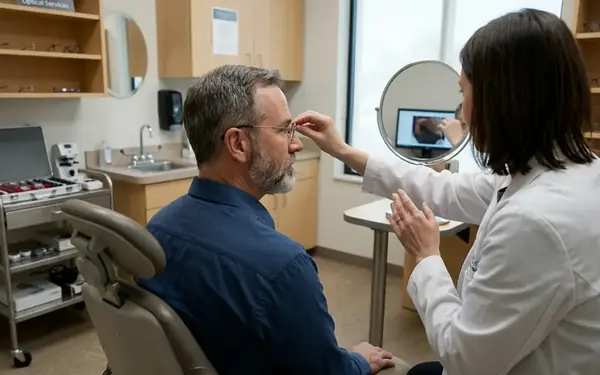
Book a comprehensive contact lens fitting that includes corneal topography, and ask specifically to trial a customized toric lens on your own eyes. Bring your headache pattern and your blur history to that appointment. That map and that trial, evaluated together at the slit-lamp, are what turn a frustrating prescription into vision that holds still.