What a Screen Can Measure
Can a smartphone screen accurately determine the health of your eyes, or does it merely measure how well you see?
Consider someone in Broken Arrow whose glasses have started to feel weak. An online test may help estimate whether the prescription needs changing. It cannot show why vision changed. That distinction matters because a person can read small letters while an eye condition develops outside the part of vision the test measures.
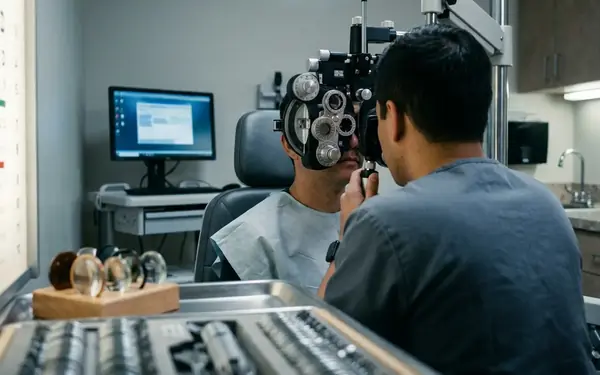
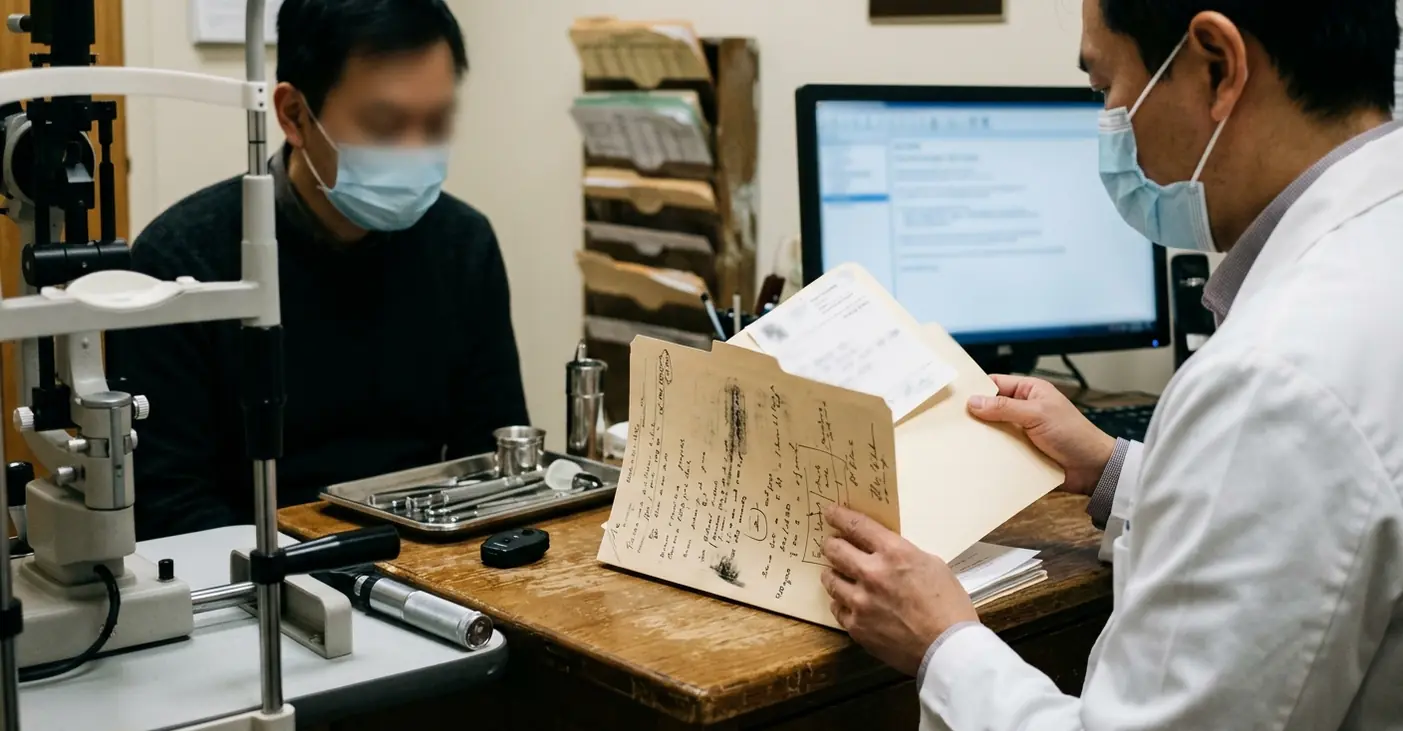
A vision screening checks performance on a defined task, usually identifying letters or symbols at a set distance. Some online tools use those answers to estimate refractive error: the amount of optical correction needed to bring an image into focus. A comprehensive eye exam also measures vision, then examines the structures and functions that support it. The clinician can assess the cornea, lens, retina and optic nerve, check how the eyes work together, and interpret findings alongside symptoms and health history.
Digital refraction tools caught on because renewing a familiar glasses prescription can be inconvenient. A person with stable vision may want a quick way to replace eyewear without arranging a full visit at that moment. That is a reasonable use to examine, provided the test’s eligibility rules are met and the result is treated as a limited prescription estimate.
The dividing line is the question each service can answer. An online result may suggest a change in lenses. An in-person exam can investigate whether that change reflects ordinary refractive error or something requiring clinical attention.
How a Phone Estimates a Prescription
A phone-based test presents letters, shapes or directional symbols and asks the user to identify what appears on the screen. The software combines those responses with information about screen size and viewing distance. Some systems ask the user to stand back from a second display; others use a phone as the response device. Either way, accurate distance calibration matters. If the viewing position shifts, the apparent size of a symbol shifts with it.
The setting introduces variables an exam room controls more closely. Glare on the display, a dim room, a smudged lens or a glance over the top of glasses can alter the answers. A person may also squint through a difficult line or lean toward the screen without noticing. Repeating the task can make the result look more consistent without resolving the cause of those errors.
Eligibility deserves equal attention. The limited use described for these tools concerns healthy adults aged 18 to 39 with no history of eye disease. Children and people with known eye conditions need a different level of assessment. Corneal irregularities such as keratoconus, and severe dry eye that makes vision fluctuate, can also undermine a screen-based estimate. The optometric guidelines explain the broader role of eye exams in evaluating vision and eye health.
Measurements the screen cannot take
Refractive error is only part of a glasses or contact lens decision. A letter chart cannot measure corneal curvature, which matters when fitting contact lenses and evaluating an irregular cornea. It cannot directly assess binocular alignment: whether both eyes aim and coordinate comfortably during reading or distance tasks. Nor can it adequately evaluate accommodative function, the focusing response that changes as a person looks between near and far objects.
Those gaps become tangible when someone reports headaches after close work despite seeing the chart clearly. A prescription estimate may leave the underlying focusing or alignment issue unexplored. For a child whose visual system is developing, the distinction is more consequential: a simple acuity result does not replace assessment for concerns such as amblyopia or difficulty using the eyes together.
Eye Disease Beyond the Letter Chart
Some of the most important findings in eye care produce no early complaint. Glaucoma can damage optic nerve fibers while central vision, the vision used to read a screen, still seems clear. Peripheral vision may change gradually enough that a person does not notice until damage has progressed. Because lost optic nerve tissue cannot be restored, a reassuring online acuity score is a poor basis for postponing an eye health assessment.
Retinal disease presents a similar problem for a different reason. Diabetes can affect the tiny blood vessels of the retina before vision becomes noticeably blurred. Macular degeneration involves changes in the central retina that also require an examination of the tissue to evaluate. These conditions cannot be diagnosed by asking someone to read a phone display, even when the person completes the task carefully.
A screening result still has value within its scope. It can indicate that a person is having trouble seeing a target and may need further evaluation. What it cannot establish is that the optic nerve, retinal blood vessels or macula are healthy. That is the eye-health limit behind the distinction between clear sight and a healthy eye.
Clear Letters, Hidden Changes
If a person has diabetes, a family history of glaucoma, new visual symptoms or another eye-health concern, a clear online score should not delay an in-person exam.
Symptoms can also change the urgency of care. Sudden vision loss, new flashes or a shower of floaters, a dark curtain in the field of vision, or a painful red eye calls for prompt clinical assessment rather than another online test.
What the Exam Room Reveals
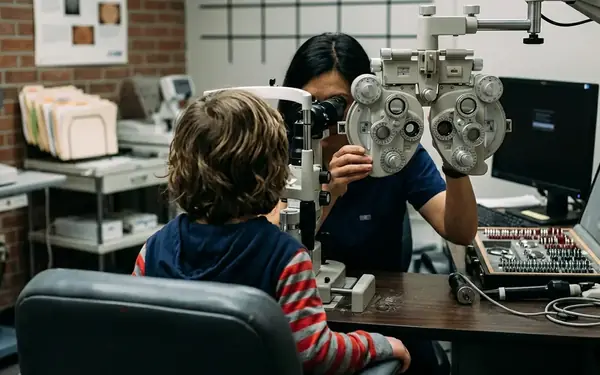
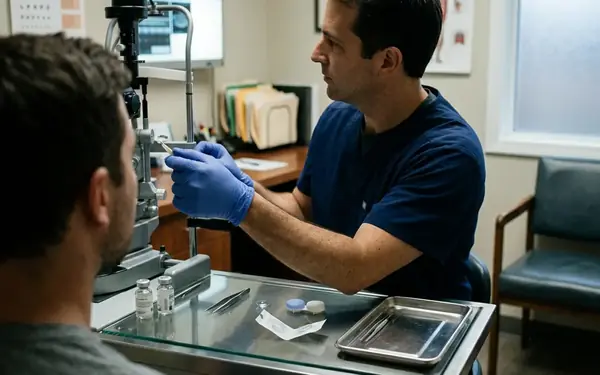
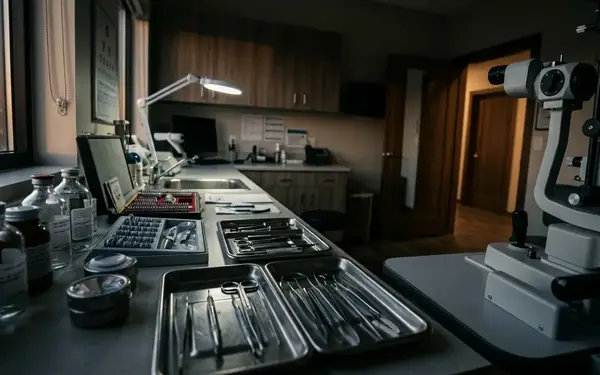
At an in-person visit, the clinician can compare what the patient sees with what the eyes physically show. A slit-lamp biomicroscope provides a magnified, illuminated view of structures at the front of the eye. With appropriate examination techniques, it also helps assess deeper structures. The clinician can inspect the tear film and cornea, look for lens changes and examine findings that a prescription test cannot display.
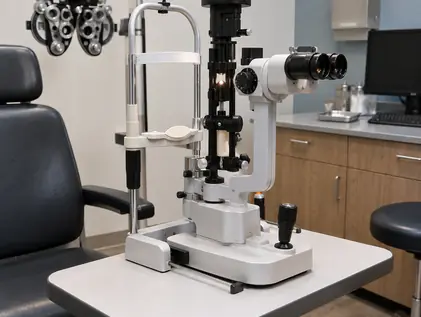
For someone considering contact lenses, this physical view matters. Lens comfort and clarity depend partly on the ocular surface. Severe dryness or an irregular cornea may change the fitting plan even if the person can identify every symbol on a digital test.
The retina requires its own careful view. Dilating drops enlarge the pupils so the clinician can examine the macula, optic disc and peripheral retina more thoroughly. Wide-field retinal imaging can document a broad view and help track visible changes over time. A photograph and a dilated examination provide different kinds of information; the clinician chooses and interprets them in light of the patient’s history and the findings at the visit.
Glaucoma assessment also extends beyond reading letters. Tonometry measures intraocular pressure, an important piece of the evaluation. The clinician considers that measurement with the appearance of the optic nerve and, when indicated, other testing. Pressure alone does not settle whether glaucoma is present.
This combination of measurements explains why a clinical exam takes a different form from a remote screening. One method asks the patient to report what they can see. The other pairs those answers with direct examination of the eye, giving the clinician a way to investigate changes before they become obvious in daily life.
| Capability | Online vision test | In-person clinical exam |
|---|---|---|
| Checks visual acuity | Estimates performance on a screen-based task | Measures vision under controlled conditions |
| Assesses cornea and tear film | Cannot examine these structures | Allows direct examination |
| Evaluates glaucoma risk | Cannot assess the optic nerve or eye pressure | Can include tonometry and optic nerve evaluation |
| Examines the retina | Cannot visualize retinal tissue | Can use dilation and retinal imaging when appropriate |
A Practical Boundary for Online Tests
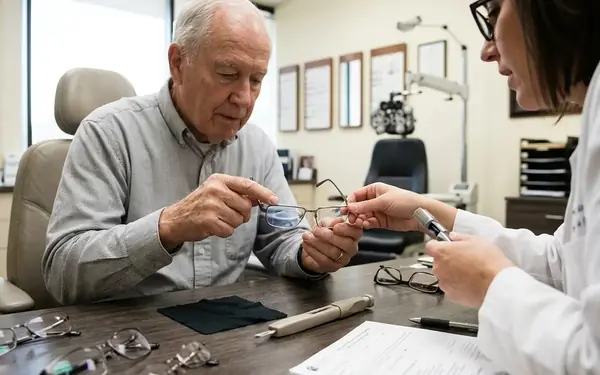
A useful plan starts with the reason for the test. If glasses are lost during travel and a healthy adult needs a temporary replacement, an eligible online prescription service may help bridge the gap. The person should check what the service actually provides, whether it accepts their current prescription history and how its result can be used for replacement glasses. A temporary update is a bridge back to regular care, not a record of ocular health.
- Check eligibility before starting. Review the service’s age, health and prescription requirements. Skip the remote test if vision has changed suddenly or symptoms suggest an eye-health problem.
- Use the result for its stated purpose. An online estimate may help with straightforward glasses replacement. Contact lenses need fitting and ocular-surface assessment that a screen cannot supply.
- Keep the full eye exam on the calendar. Regular in-person eye exams & care provide the opportunity to evaluate eye health & conditions alongside the prescription. The appropriate schedule follows the patient’s history, findings and clinician’s recommendation.
- Bring changes to the visit. Note whether blur occurs at distance, during reading or in one eye. Mention headaches, double vision, diabetes, a family history of eye disease and any difficulty adapting to glasses & frames.
Family scheduling makes the boundary especially useful. An adult replacing a familiar pair of glasses has a different question from a parent arranging a child’s first exam. Children may have trouble describing blur, and a school or home screening can miss aspects of eye development. A clinical visit gives the family a place to address visual acuity, eye coordination and ocular health together.
Online testing works best when its narrow purpose stays visible: estimating how well someone sees a target under the test’s conditions. The next time a prescription feels wrong, is the immediate task to replace known eyewear, or to find out why vision changed?