What a Compressing Basketball Does to the Globe
What happens to the structural integrity of the human eye when a size 7 basketball reaches the orbital bone at competition speed? Most people assume the bony ring around the eye does its job. It usually does, right up until the object striking it stops behaving like a rigid sphere.
A size 7 ball compresses on contact, with the reduction in radius estimated at roughly 18 to 22 millimeters. That deformation is the whole problem. A rigid ball of that diameter would bridge across the supraorbital ridge, the zygomatic process, and the maxillary rim, transmitting load into bone. A compressing ball conforms to the orbital opening, fills the socket, and loads the globe directly.
The velocities are not trivial either. High school competition routinely involves passes traveling between 35 and 42 miles per hour, and a rebounding scrum adds elbows, forearms, and fingers moving on unpredictable vectors. The teen athlete who needs vision correction faces this environment with one of three arrangements: everyday glasses, contact lenses, or nothing at all. Each carries a distinct failure profile.
Anatomically, the orbit is a cone of thin bone with one deliberately weak floor. Blunt loading of the globe raises intraorbital pressure, and that pressure has to go somewhere. It goes down, through the orbital floor, which is where blowout fractures come from. The eye that absorbs a compressed ball face-on is also the eye that can suffer commotio retinae, angle recession, or hyphema without a single visible laceration.
Where Everyday Corrective Lenses Give Out on the Court
Dress eyewear is engineered for a dropped ball bearing, not a contested rebound. That distinction shows up in the numbers.
The CR-39 Fracture Threshold, Broken Down
Standard CR-39 plastic lenses typically fracture into sharp shards once blunt force impact exceeds roughly 0.2 to 0.3 joules of kinetic energy. Put that threshold next to a 35-to-42-mile-per-hour pass and the arithmetic stops being interesting. The lens does not simply crack; it liberates edged fragments directly in front of the cornea, driven inward by the same energy that broke it.
Secondary trauma from frame materials compounds the picture. Cellulose acetate becomes brittle with age and heat cycling, and it breaks into wedge-shaped pieces. Metal frames introduce hinge screws, nose pad arms, and temple ends into the orbital space. In a typical dress frame, the lens is retained by a shallow groove and a single closing screw, so the failure sequence tends to be lens displacement first, then frame collapse, then whatever the fragments do on their way through.
Everyday polycarbonate improves the material story considerably. The architecture stays wrong. Thin edges, small eye sizes, flat base curves, and no retention strap mean the lens can pop cleanly out of the frame while remaining intact, which removes the only barrier at the exact moment it is needed.
The Contact Lens Trade-Off
Contact lenses solve the optical problem elegantly. Unobstructed peripheral vision, no frame in the visual field, no fogging on a fast break, no slippage during a sprint. Within the scope of refractive correction, they are excellent.
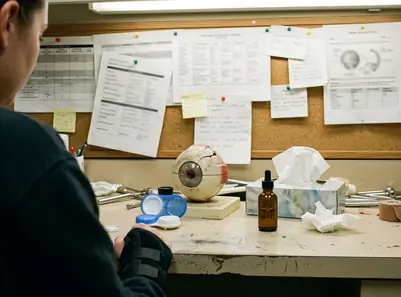
They offer zero structural protection against blunt force trauma. The cornea, the anterior chamber, and the globe remain entirely exposed, and a soft lens contributes nothing to energy absorption. An athlete in contacts is, mechanically speaking, an athlete playing with an unprotected eye who happens to see well.
The Real Failure Point
The material of the lens matters less than how the lens is held. Impact-resistant plastic that leaves the frame under load has protected nothing. Retention geometry is the variable that separates a scuffed frame from an emergency referral.
Building the Frame: Polycarbonate, Wrap, and Silicone Load Paths
Sports goggles built to the ASTM F803 standard are qualified against a defined ballistic test rather than a drop test. Certification requires the eyewear to withstand a 40-millimeter projectile fired at speeds ranging from 88 to 92 miles per hour with no lens displacement and no frame failure. That is roughly double the velocity of a hard chest pass, tested against a projectile sized to interact with the orbital opening the way a compressed ball does.
Impact-grade polycarbonate earns its place through ductility. Under load it deforms and absorbs energy rather than propagating a crack front, and it carries inherent UV absorption, which is a useful side benefit for outdoor play. The material also has a lower Abbe value than CR-39, meaning chromatic aberration becomes a real design consideration once the lens gets thick or steeply curved.
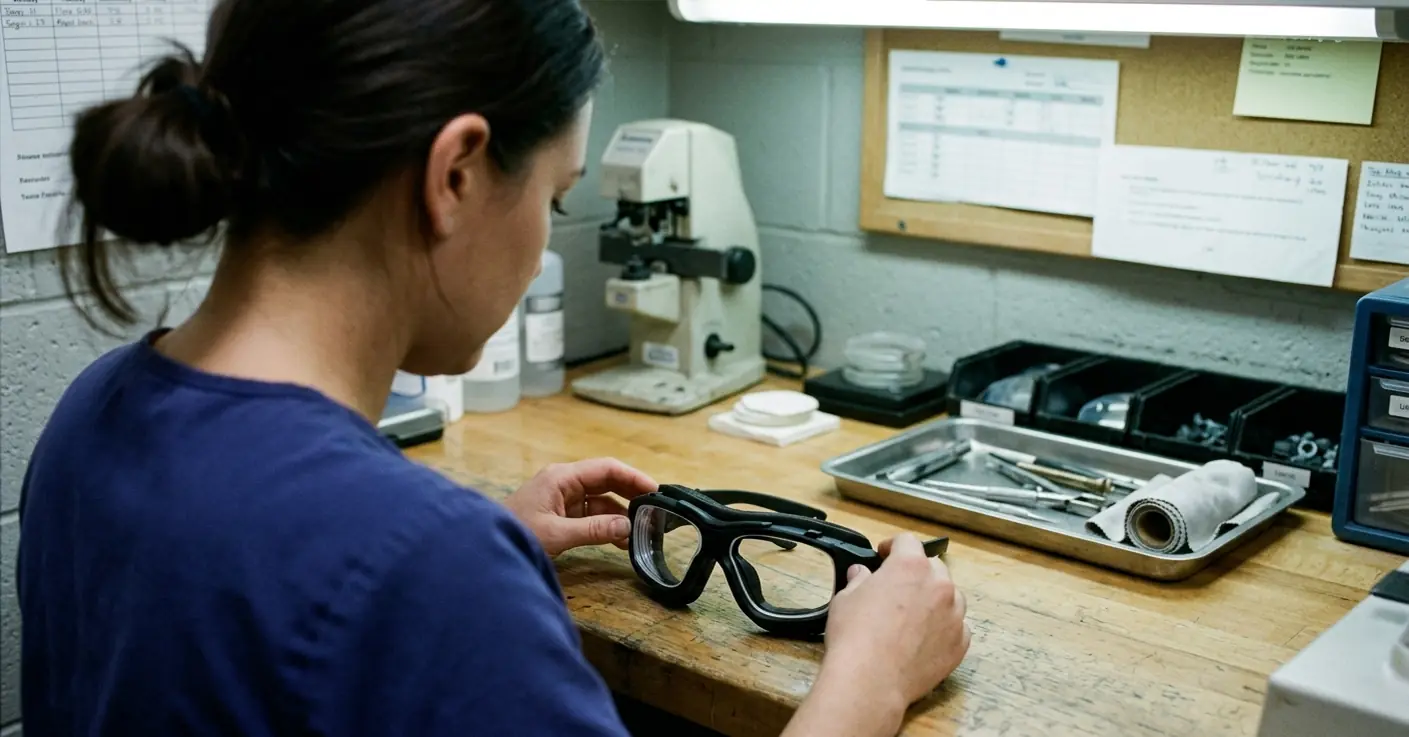
Frame architecture does the work that the lens cannot. A high-wrap shell seats the lens in a deep bevel groove and retains it from the front, so impact energy pushes the lens into its retention rather than out of it. Silicone padding across the bridge and brow then extends the duration of the load and redirects it onto the frontal bone and the zygomatic arch, the two structures best equipped to take it. Longer load duration and a wider contact patch both reduce peak force at the globe.
Digital Surfacing at the High-Wrap Boundary
Fitting a prescription into that geometry is where implementation gets stubborn. Standard base-curve polycarbonate lenses, mounted in a high-wrap sports frame, produced unacceptable peripheral distortion for the athlete in question. The optics were being asked to work at a wrap angle they were never calculated for.
Traditional grinding methods came up for evaluation and were discarded: reducing curve mismatch by conventional surfacing thinned the lens edges below the safety threshold of about 3 millimeters, which would have compromised the structural integrity the frame depends on. A thinner edge in a bevel groove is a lens looking for a way out.
Digital surfacing resolved the conflict by recalculating the optical center across the high-wrap frame, compensating for wrap angle and pantoscopic tilt while holding edge thickness inside the safety margin. Visual acuity stayed sharp through the periphery, and the lens kept the mass and thickness distribution that make the retention system work.
The protective efficacy of F803-rated goggles drops off noticeably if the silicone bridge padding degrades, or if the athlete's facial bone structure has not yet developed enough to support the frame's energy-dispersion architecture. Both conditions apply to growing teenagers, which is why refit intervals matter as much as the original dispense.
Rebounding Sequence, Late 2019: An Elbow and a Ball Strike
During a late 2019 winter athletic season game, the design assumptions got tested without anyone volunteering. Contesting a rebound, the athlete took an opponent's elbow directly to the temporal orbit, and the ball struck the same side a fraction of a second later as it came off the rim. Two impacts, one vector, no time between them for the head to move away.
Post-incident examination in the Broken Arrow clinic documented a 14-millimeter scuff mark across the temporal bridge of the frame, along with visible stress marks where the shell had flexed. The lenses had not displaced, cracked, or shattered. The frame absorbed the geometry change and returned to shape, which is the behavior the polycarbonate shell is designed for.
The patient was evaluated within 45 to 60 minutes of the court collision. Slit lamp examination showed zero signs of anterior chamber bleeding, and the clinical picture carried no hyphema, no orbital fracture, and no globe rupture. Soft tissue bruising along the temporal brow marked the full extent of the injury. The energy that would otherwise have loaded the globe went into the frame, the silicone, and the bone behind it.
Post-Impact Frame Check
- Inspect polycarbonate lenses for micro-fractures or stress crazing along the bevel.
- Measure silicone bridge padding compression recovery; it should return to original thickness within 2 to 3 minutes.
- Confirm lens seating depth in the retention groove on both temporal and nasal edges.
- Check temple and strap anchor points for elongation or hairline separation.
- Document scuff location and depth so repeat impacts to the same zone can be tracked.
- Schedule dilated posterior segment evaluation before return to play, even with a clean anterior exam.
Reclassifying Goggles as Protective Medical Equipment
The practical shift is a category change. Sports goggles get shelved mentally alongside glasses and frames, filed under vision correction, priced against fashion eyewear. They belong in the same equipment category as a mouthguard: a piece of protective medical hardware that happens to carry a prescription.
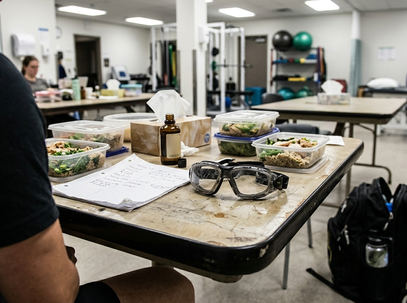
There is a performance dividend that rarely makes it into clinical notes. Athletes who trust their eyewear play differently. They contest rebounds, take charges, and keep their eyes open through contact, because the fear of an eye injury has stopped editing their decisions. Removing that hesitation improves both the athlete's game and, indirectly, their safety, since flinching mid-contact is its own injury mechanism.
The human orbital rim naturally blocks rigid objects above a diameter estimated at roughly 50 millimeters, which sounds like adequate protection until the object stops being rigid. A rapidly compressing basketball can still produce globe deformation measured around 3 to 5 millimeters on impact, and that millimeter range is where hyphema, angle damage, and retinal insult live. An energy-dispersing polycarbonate frame is the physical barrier standing in those few millimeters.