The Physical Burden of High Diopters
A patient with severe myopia pushes their glasses up several times during a conversation. The lenses sit heavily on the bridge, the outer edges extend beyond the frame, and deep red indentations remain when the glasses come off.
This discomfort begins with the amount of lens material required to correct a strong prescription. A minus lens used for myopia is thinnest at its optical center and grows thicker toward the edge. A plus lens for hyperopia follows the opposite geometry: its center carries most of the thickness. Standard CR-39 plastic, with a refractive index of 1.50, requires more curvature and material to produce higher optical powers.
Why thickness affects daily wear
Lens bulk changes more than appearance. Added weight concentrates pressure on the nasal bridge and behind the ears. Thick peripheral edges can also enlarge the visible contour of a minus lens, while strong plus lenses may magnify the wearer’s eyes.
High-index materials address these problems by bending light more efficiently. They allow the prescribed power to be produced with flatter curves and less physical volume, improving comfort and cosmetic balance without weakening the intended correction.
How Refractive Index Changes Lens Geometry
The refractive index measures how efficiently a lens material bends light. As the index rises, less curvature is generally needed to achieve the same prescription. CR-39 sits at 1.50, while commonly dispensed high-index options include 1.67 and 1.74.
Thinness comes with an optical trade-off
Material selection also involves the Abbe value, which describes how readily a lens separates light into its component colors. A higher Abbe value generally means less peripheral color dispersion. CR-39 has an Abbe value of 58; 1.67 material drops to 32, increasing the possibility of colored fringes or mild blur when the wearer looks away from the optical center.
The Broken Arrow clinic’s dispensing protocol illustrates why the thinnest available material should not become an automatic default. The optical team considered using 1.74 lenses for every prescription above -5.00 diopters. Trial fittings showed that some wearers doing visually demanding tasks noticed chromatic aberration associated with the material’s Abbe value of 33. The clinic instead matched the material to the prescription, frame, visual task, and wearer sensitivity.
Peripheral Color Check
During dispensing, the wearer should look through the lens center and then shift the eyes toward high-contrast objects at the side of the room. Colored outlines, swim, or unexpected peripheral blur may indicate that material choice, frame position, or optical centering needs review. Abbe values describe material behavior; individual perception still requires an in-person check.
Matching Prescription Power to Lens Material
High-index selection works best as a sequence rather than a single diopter cutoff. The optician first reviews the sphere, cylinder, and axis in each eye. The frame dimensions and pupil position then reveal how much of the thick peripheral lens blank must be retained.
A practical material sequence
- Review prescriptions near or beyond +/-4.00 diopters. At this range, high-index material often provides a visible thickness benefit, especially in frames with a larger eye size.
- Use 1.67 for moderate-to-high powers. This material usually offers a useful balance among edge reduction, optical behavior, and frame compatibility. For a -5.25 diopter lens, moving from standard plastic to 1.67 typically reduces edge thickness by 1.8 to 2.4 millimeters.
- Reserve 1.74 for the strongest prescriptions. Its main advantage is maximum edge reduction when lens thickness would otherwise dominate the finished eyewear.
- Evaluate impact and mounting needs. Polycarbonate may suit eyewear that prioritizes lower weight and impact resistance. A drill-mounted rimless design requires particular caution because 1.74 material lacks the tensile strength needed around mounting holes and can crack under ordinary daily torsion.
Reducing lens volume can lower the finished eyewear weight and ease facial pressure. The result still depends on the frame, prescription distribution, and lens blank required during fabrication. Anti-reflective coatings are also valuable on high-index lenses because these materials reflect more surface light than standard plastic.
Frame and Dispensing Choices That Control Edge Thickness
Material solves only part of the thickness problem. Frame geometry determines how far the lens extends from the optical center, and every extra millimeter can preserve more of the thick outer zone in a minus prescription.
Choose the frame before ordering lenses
- Keep the eyes centered. A frame that places each pupil close to the geometric center reduces decentration and allows a smaller effective lens diameter.
- Favor compact, rounded shapes. For prescriptions beyond -6.00 diopters, an eye size between 46mm and 50mm helps remove the thickest peripheral areas of the blank.
- Avoid oversized frames. Wide lenses retain more edge material and can erase much of the benefit gained from a higher index.
- Use full rims when thickness is substantial. A well-fitted acetate or metal rim conceals the lens edge more effectively than a rimless design.
Verify the finished eyewear
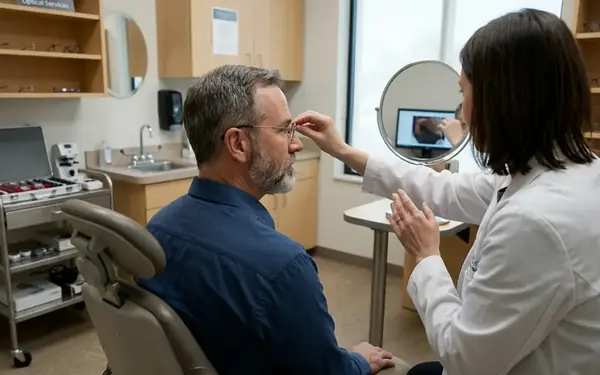
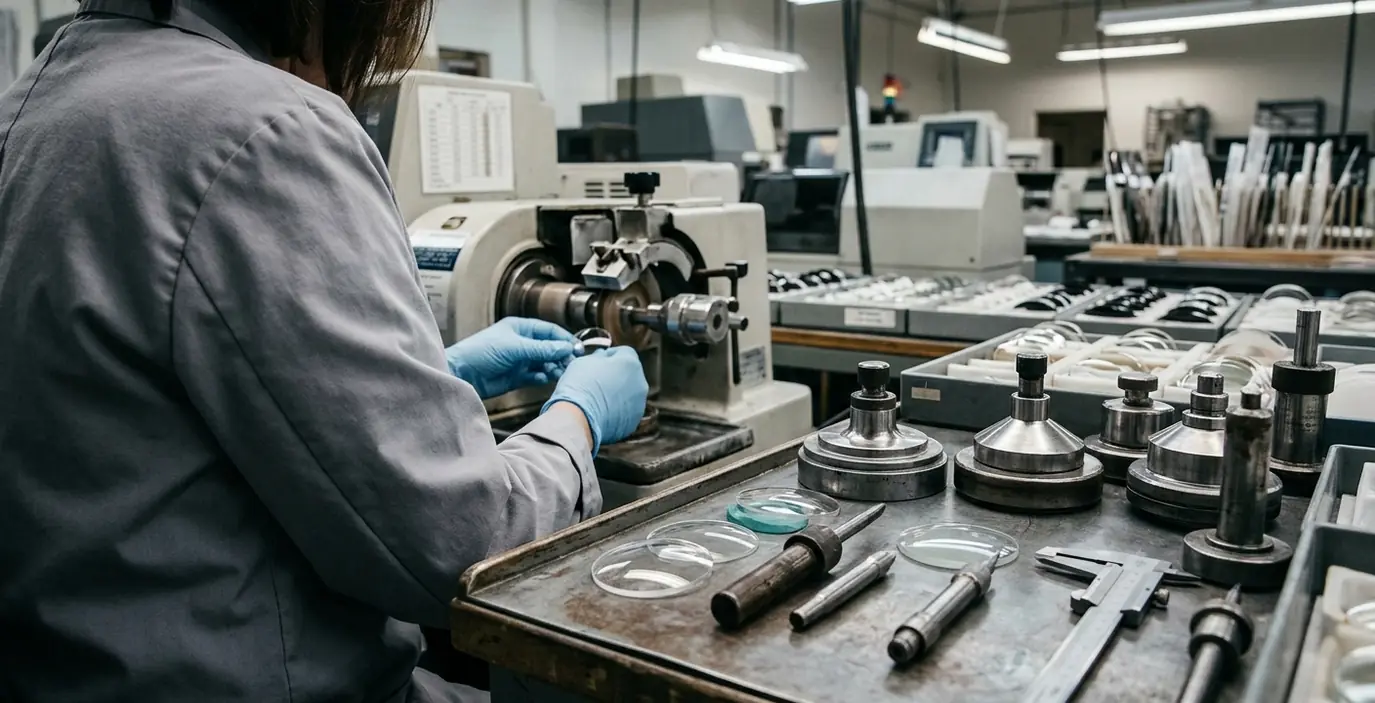
The dispensing process should include monocular pupillary distance measurements, fitting height, frame tilt, and bridge position. These measurements keep the optical centers aligned with the wearer’s eyes and reduce unwanted peripheral effects. Custom high-index lenses generally require several business days for surfacing, edging, and application of anti-reflective coatings before final fitting.
At pickup, the optician should level the frame, adjust the temples, inspect edge placement, and confirm clear vision through the intended gaze positions.
Check the diopter values on your current prescription, then schedule a licensed optician fitting to measure your pupillary distance and choose a compact frame that centers each eye within the lens opening.