Table of Contents
- Why the Crystalline Lens Stops Flexing in Your Forties
- How Concentric Rings and Aspheric Zones Share the Focus
- Multifocals, Monovision, or Readers Over Contacts
- Inside the Multifocal Fitting Visit and the Weeks After
- Why First-Time Wearers Should Start With Daily Aspheric Lenses
Why the Crystalline Lens Stops Flexing in Your Forties
Close-up focus depends on the crystalline lens changing shape. When the ciliary muscle contracts, tension on the lens eases and the lens rounds up, which adds focusing power. That flexibility stiffens steadily with age. By the fourth and fifth decades of life, the lens no longer bends far enough to keep small print sharp.
The numbers are blunt. Accommodative amplitude sits at roughly 12 to 14 diopters in early adolescence and falls below 2 diopters somewhere between ages 42 and 48. As it drops, the near point of accommodation recedes past the standard 40-centimeter reading distance, often out to 55 or 65 centimeters. That is the arm's-length phone posture any optometrist can spot from across the waiting room.
Age alone does not decide the diagnosis. In the exam lane, clinicians confirm clinical presbyopia by measuring push-up amplitude of accommodation, and the birthday only tells us when to start checking. The National Eye Institute overview of presbyopia covers the basics if you want a plain-language primer.
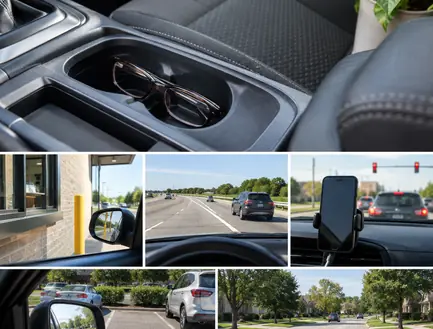
Picture a typical patient who commutes on the Broken Arrow Expressway. Her distance contacts make the road crisp. Her dashboard gauges and infotainment screen, though, sit at an intermediate 60 to 80 centimeters, a dead zone for anyone wearing single-vision distance correction. So a pair of drugstore readers lives in the cupholder. On at the pharmacy drive-through. Off to merge. On to read a text at a red light. Off to back out of a parking space.
Suburban driving life is a chain of short errands, and every stop demands a focus switch. That relentless on-and-off cycle brings more people into the office than any single unreadable label.
How Concentric Rings and Aspheric Zones Share the Focus
Bifocal spectacles work by location. You look down through the reading segment and up through the distance portion. A contact lens moves with the eye, so that trick is off the table. Multifocal contact lenses instead project distance, intermediate, and near images onto the retina at the same moment. This is called simultaneous vision, and the brain does the sorting, choosing whichever image matches what you are looking at.
Two optical layouts dominate soft multifocal design.
Concentric Alternating Rings
Concentric designs stack discrete annular zones of distance and near power across the lens, spaced at about 0.5 to 0.8 millimeter intervals. Because the rings repeat, each focal plane still reaches the retina even if the lens sits slightly off center. The weak point is the pupil. In bright light the pupil constricts and the iris can block the outer rings entirely; in dim light it opens and the balance between distance and near shifts. A patient with naturally small pupils may never use the outer distance zones at all.
Aspheric Center-Near Gradients
Aspheric lenses blend power continuously. A typical center-near design carries the full reading add across a central 2.5 to 3.2 millimeter optical zone, then grades smoothly out to the distance prescription in the periphery. There are no visible transition lines, much like a progressive eyeglass lens. Diagnostic trial sets group the reading addition into Low (+0.75D to +1.25D), Medium (+1.50D to +1.75D), and High (+2.00D to +2.50D) brackets.
Before pulling a single lens from the fitting set, measure pupil diameter under both bright (photopic) and dim (mesopic) clinic lighting. That measurement, more than personal preference, points toward rings or gradient.
Multifocals, Monovision, or Readers Over Contacts
Most presbyopic contact lens wearers end up choosing among three options. Here is how they line up on the measures that matter day to day.
| Approach | How it works | Depth perception | Contrast and low light |
|---|---|---|---|
| Multifocal contacts | Both eyes see distance and near simultaneously | Binocular, preserved | Low-contrast acuity can drop about 0.5 to 1.5 Snellen lines in dim settings; some halos possible |
| Full monovision | Dominant eye for distance, non-dominant eye for near | Stereopsis falls from a normal 20 to 40 arcseconds to 100 to 200 arcseconds when the power difference exceeds 1.50D | Each eye sees one focal plane clearly |
| Readers over single-vision contacts | Distance contacts plus spectacles for near | Fully preserved | Keeps 100% of baseline retinal illumination and contrast |
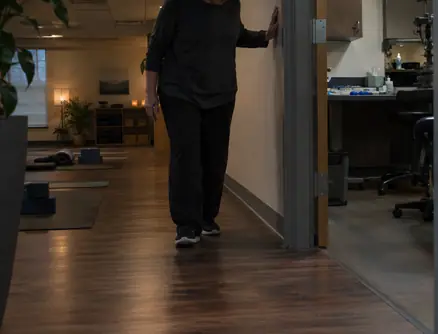
Readers win on raw image quality and lose on convenience, which is the whole problem our commuter brought in. Monovision looks elegant on paper. In practice, a demonstration with loose trial lenses over a patient's distance contacts can feel fine in the chair and fall apart when the patient walks down the clinic hallway and the floor seems to tilt. That loss of stereoacuity matters for highway lane changes, judging a curb, or tracking a tennis ball.
Multifocals keep both eyes working together, which is their central advantage for driving and active recreation. The cost is a modest contrast penalty in dim light. A middle route, modified monovision, pairs a single-vision distance lens on the dominant eye with a +1.50D or +2.00D add multifocal on the non-dominant eye, protecting most binocular function while boosting near.
Where Multifocals Win
If your day mixes highway driving, dashboard glances, and phone reading, binocular multifocals cover all three distances without sacrificing depth perception.
Inside the Multifocal Fitting Visit and the Weeks After
A multifocal evaluation runs differently from a routine refraction. There is less "which looks sharper, one or two" behind a dark phoropter and more real-world testing with the lights up. Before anything else, the clinician assesses ocular dominance and, for spectacle prescriptions beyond plus or minus 4.00 diopters, mathematically vertex-corrects the power from the 12-millimeter spectacle plane to the corneal surface.
From there, the assessment moves through three sequential gates:
- Tear film first. A non-invasive tear breakup time of at least 8 to 10 seconds is needed to keep a smooth optical surface over the lens's power gradients. In Oklahoma, spring pollen and dry, persistent wind thin the tear film fast. If it breaks up early, the optics smear no matter how good the lens design is, so dry eye gets treated before the fitting continues.
- Pupils second. Photopic and mesopic pupil apertures confirm the iris will not hide outer concentric rings.
- Over-refraction last. After the diagnostic lenses settle on the cornea for about 15 minutes (stabilization typically takes 12 to 20), the optometrist performs a binocular loose-lens over-refraction in 0.25-diopter steps, in a fully lit room, using nutrition labels and your own phone as targets.
Bring Your Real Targets
Bring the phone you actually use, and mention the screens you read at work. Testing on your own devices makes the over-refraction far more useful.
Teaching the Visual Cortex to Pick a Focal Plane
Every multifocal lens lays a blurred image on top of the sharp one. The primary visual cortex has to learn to suppress that overlay. This cortical neuroadaptation spans 10 to 21 days of consistent wear, at least 6 to 8 hours per day. The trial lenses need to go to work, into the car, and onto the couch at night, because a ten-minute test in the exam chair says little about a Tuesday afternoon commute.
Day Three Is Too Early
Judging multifocals after a few days, or wearing them only part-time, stalls adaptation. Finish the full trial window before deciding they do not work for you.
Why First-Time Wearers Should Start With Daily Aspheric Lenses
Simultaneous optics divide incoming light across several focal points. For most of life that trade is invisible. For intricate close work in dim light, such as fly-tying in a garage or reading a dense paperback by lamplight, it shows. The fix is a mild pair of over-glasses, typically +0.75D to +1.25D, worn directly over the contacts. A +1.00D pair handles most of these patients well, and it beats over-plussing the contact lens itself, which only steals distance clarity.
Standard soft multifocal trials also have practical boundaries: cap them at 1.00 diopter of refractive cylinder and a maximum +2.50D reading add. Patients with more astigmatism than that tend to see ghosting and do better in custom toric rigid gas permeable or hybrid designs.
Lens replacement schedule matters more for multifocals than for single-vision lenses. Over a four-week wear cycle, lipid and protein deposits build up on reusable lenses, and even microscopic films scatter light across the focal zones, bringing on glare earlier in the day. Daily disposable silicone hydrogel multifocals sidestep that buildup and deliver oxygen transmissibility between 90 and 156 Dk/t units, which, in eyes with regular corneas and modest cylinder, prevents the late-day corneal swelling that distorts aspheric optics.
I tell every new presbyopic contact lens patient the same thing: start with a daily disposable aspheric silicone hydrogel multifocal. The fresh surface each morning keeps the tear film stable over the optics, the oxygen keeps the cornea clear through the evening drive, and the smooth power gradient gives your visual cortex the easiest possible image to learn. Fit that lens first, give it the full adaptation window, and keep a +1.00D pair of over-glasses in the nightstand for lamplight reading.