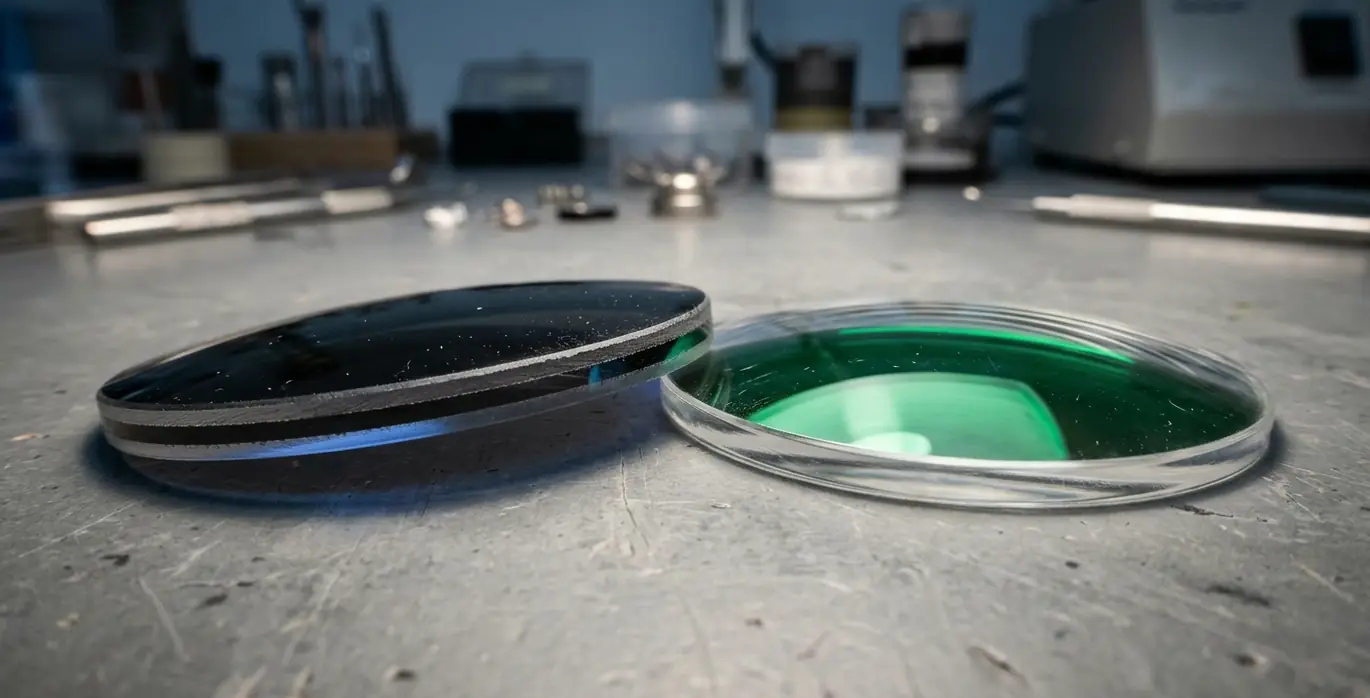
How Low Sun and Wet Roads Produce Driving Glare
Commuter glare combines concentrated reflections from road and vehicle surfaces with scattered light and overlapping reflections inside the cabin. The most troublesome component often comes from sunlight reflecting off wet asphalt: a bright, partly polarized sheet of light that competes with lane markings, pedestrians, and surface detail.
Polarized lenses address reflected roadway glare; anti-reflective coatings address reflections at the spectacle lens surfaces. Driving glasses can incorporate both treatments because each acts on a different part of the light path.
Why Flat Surfaces Create a Directional Reflection
Sunlight contains light waves with electric fields oriented in multiple directions. When sunlight strikes a dielectric surface, such as water or glass, the surface reflects those orientations unequally. At particular viewing angles, the reflected light becomes strongly polarized. For a broadly horizontal road surface, the dominant reflected orientation is horizontal.
Low morning and late-afternoon sun puts these reflections close to the driver's forward view. Wet pavement provides a smoother reflecting surface than dry, textured asphalt, making the reflected patch more concentrated. A sloped windshield introduces another reflecting plane. Metallic bodywork also produces specular glare, although its polarization behavior differs from that of water and glass.
Clear prescription lenses bring the road scene into focus while transmitting this intense reflected light. Correcting focus therefore leaves a separate glare-control task. The useful question is where the objectionable light originates: across the road surface, at the spectacle lenses, or elsewhere along the viewing path.
What Polarizing Film and AR Layers Do Inside a Lens
A polarized prescription lens contains an aligned chemical filter within its structure. An anti-reflective, or AR, coating sits on the lens surface. Comparing their locations makes their functions easier to specify when ordering glasses.
Polarization Selectively Absorbs Light
A common polarizing construction uses stretched polyvinyl alcohol film treated with iodine. Stretching aligns the film's molecular structure, producing different absorption along different orientations. Manufacturers incorporate the film into the lens so that its transmission axis passes predominantly vertical polarization and suppresses the horizontal component associated with roadway reflections.
The familiar Venetian-blind analogy describes this selectivity, although the filter works through molecular absorption. Its practical effect is strongest where the reflected light has a substantial horizontal component. A driver may see wet-road glare diminish while surrounding objects remain visible through the sunglass tint.
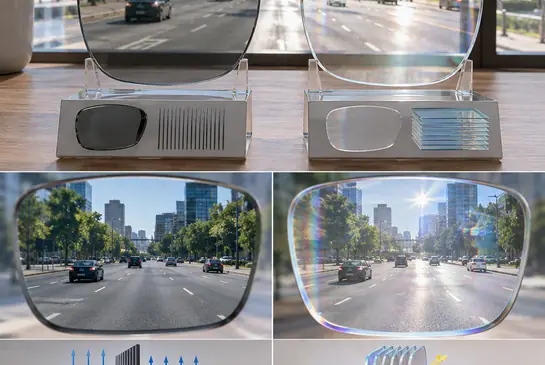
AR Coatings Reduce Surface Reflections Through Interference
Vacuum-deposited AR coatings use thin layers of materials with different refractive indices, including silicon dioxide and zirconium dioxide. Reflections from their interfaces return with carefully controlled phase relationships. Destructive interference reduces reflected light across the coating's intended visible range.
This treatment increases transmission through the lens and reduces spectacle-generated ghost images. On clear driving glasses, front- and back-surface AR helps preserve useful light after dark. On polarized sunglasses, a back-surface coating reduces reflections from light entering behind the wearer. The faint green or blue residual reflection identifies a surface response, not the presence or strength of polarization.
Why Clear AR Lenses Belong in the Night-Driving Pair
Night driving calls for an untinted prescription lens with effective surface-reflection control. A polarizing filter absorbs part of ambient light as it selects polarization orientations. That absorption makes a functional polarizer unsuitable as a completely clear night-driving solution.
As daylight fades, road hazards become harder to distinguish from their backgrounds. Dark clothing, an unlit obstacle, and the edge of a wet shoulder may offer little contrast. A tinted lens further reduces the light available to resolve those details, even when bright headlights feel less uncomfortable through it. Pupil dilation cannot fully compensate for that loss.
Dusk Requires Clear Lenses
Change into the clear pair before fading light makes road detail difficult to distinguish. Complete the exchange while parked safely, with the correct glasses positioned securely before moving.
Dual-surface AR supports night vision by reducing the portion of glare generated at the spectacle surfaces. This matters when intense LED or high-intensity discharge headlights create secondary reflections through the lenses. A clean, untinted lens preserves more available light while keeping those reflections lower.
Persistent halos, starbursts, or a recent change in night vision warrant an eye examination. Those symptoms can involve prescription accuracy, the ocular surface, or other eye conditions. A coating purchase should follow that assessment when symptoms have changed.
Matching Lens Material, Daytime Tint, and Dashboard Visibility
Start with the prescription and frame dimensions, then compare material properties. Lens thickness, weight, impact resistance, dispersion, and surface reflection all affect the finished driving pair. Choosing the highest refractive index by default can add expense without improving the view.
Select the Substrate Before the Coating Package
- CR-39: Offers favorable chromatic performance and suits prescriptions and frames where its finished thickness is acceptable.
- Polycarbonate: Combines impact resistance with a lightweight construction. Its greater chromatic dispersion deserves attention when peripheral color fringes are bothersome.
- Trivex: Pairs impact resistance with favorable optical properties, making it a useful candidate when prescription thickness remains manageable.
- High-index plastic: Can reduce thickness for stronger prescriptions. Its increased surface reflection makes front- and back-surface AR particularly valuable.
For daytime polarized glasses, specify back-surface AR explicitly. Sunlight entering through side or rear windows can strike the concave inner lens surface and reflect toward the eye. Reducing that reflection improves the usefulness of the sunglass lens when the sun sits behind or beside the driver.
Compare Grey and Copper in the Actual Vehicle
Neutral grey preserves a relatively neutral color balance. Brown or copper changes the spectral balance by attenuating more short-wavelength light, which can make road contours feel more distinct in daylight. The tint decision should include familiar traffic signals, shaded pavement, and the dashboard, with sufficient visibility taking priority over a pleasing color cast.
Some LCD dashboards and head-up displays become dark or disappear through polarized lenses because their polarization orientations interact; test every essential display while parked, and choose a non-polarized daytime tint if visibility is compromised.
Conduct the check from the normal seating position. Read the speed display, navigation instructions, warning indicators, and head-up projection, then repeat with modest, natural head movements. A lens earns its place in the driving pair by keeping both the road and the vehicle's information readable.
Putting a Daylight Pair and Clear Pair Into Commuting Use
An eastbound morning drive followed by a return after dark provides a practical test of the two-pair approach. Each pair needs the current driving prescription, a stable frame fit, and clean optical surfaces. Set up the sequence before the first journey.
- Prepare the daylight pair. Select polarized copper lenses in Trivex or a suitable high-index material after checking prescription thickness and frame fit. Include back-surface AR. While parked, verify that essential vehicle displays remain readable.
- Prepare the clear pair. Specify untinted lenses with front- and back-surface AR. Hydrophobic and oleophobic surface treatments can make water and oily residue easier to remove during cleaning.
- Set the changeover. Keep the clear pair accessible in a protective case during the journey. Change while safely parked before dusk reduces road contrast, including when the outward trip extends later than expected.
- Control heat and contamination. Use a rigid, lined case in a shaded compartment during travel, and carry the glasses out of a parked vehicle. Excessive cabin heat can damage coatings. Rinse away loose grit, use a compatible lens cleaner, and dry with a clean microfiber cloth.
On the eastbound morning trip, the driver puts on the checked polarized copper pair before departure. Its filter reduces wet-asphalt reflections; its back-surface AR controls reflections arriving from behind. Before the evening return, the driver cleans and puts on the clear AR pair, confirms a sharp dashboard view, and secures the daytime glasses in their case. At the destination, both pairs leave the vehicle with the driver.